Strictly speaking this post is a little out of sequence but Cambodia has very much felt like a tale of two experiences for me. On the one hand, the temples old and new(er) are spectacular, the people have been incredibly friendly and positive, always (I suspect in order to practice their English) asking what we’ve been doing, when we came to Cambodia, when we’re leaving, where we’re going next, etc. The food has been delicious, featuring dishes of stir fried noodles or rice with vegetables and meat, coconut milk and lemongrass flavoured curries, but without the eye-watering chilli spice of Thai cooking. It has been easy to get around, Tuk-Tuk drivers are (we found) pretty helpful, though we made sure to get our hostel staff to help with picking one they recommended.
On the other hand the recent history of the country is harrowing, and the political situation here is still less than stable. We spent a fascinating afternoon at the War Museum in Siem Reap, where all the tour guides are volunteers who survived the war in some way, and have just got back from a day in/around Phnom Penh where we visited two museums documenting the genocide that occurred during Pol Pot’s reign between 1975-79.
The war museum taught us the general history, the Vietnam war had an obvious destabilising effect on the region, and although Cambodia remained neutral in theory during this period, the North Vietnamese forces had established smuggling routes through Cambodia which prompted US forces to start bombing campaigns and the deployment of agent orange to clear forest around the border with Vietnam. This bred a lot of anti-US feeling in Cambodia, and fed political unrest which resulted in a pro-US government being propped up by US forces, and resistance fighters with communist backing from China and Russia hiding in the forests to the north.
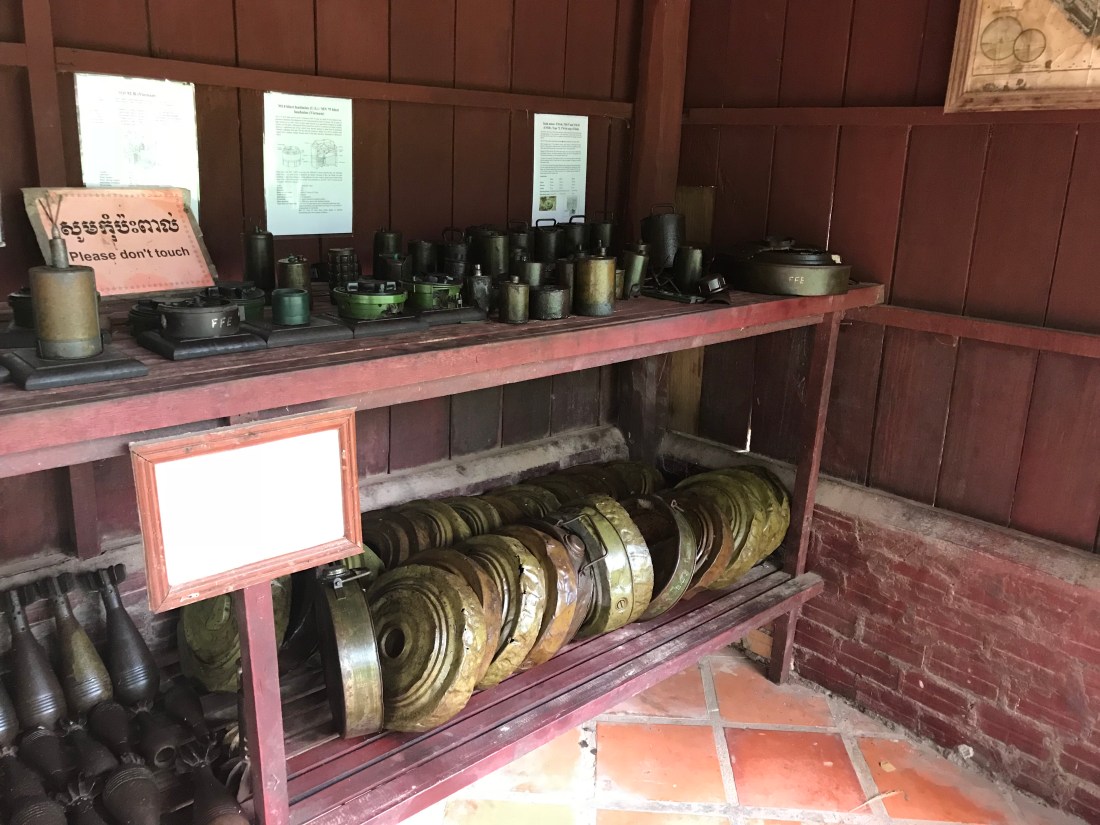
Once the Vietnam war ended in 1975, the resistance movement (the Khmer Rouge) led by their general Pol Pot quickly overthrew the government in Phnom Penh and Pol Pot became the president.
The genocide museums we visited in Phnom Penh were so moving, it’s impossible to describe the brutality and senseless loss of millions of lives. We saw one of the ‘killing fields’ at the Choeung Ek Genocidal Center, where anyone who was even suspected of dissenting against the regime was murdered and buried. This included anyone who didn’t fit the expected profile of a rural worker, so Mel and I as university-educated professionals would not have survived. Neither would anyone who wore glasses, doctors, teachers, anyone caught stealing (and those who were slaves in the fields were often forced to steal to get food to eat), and sometimes just for no reason at all (Pol Pot’s regime held a paranoid ‘better safe than sorry’ approach towards executing suspected/accused dissidents).
We also saw the ’S21’ prison, another genocide museum at the site of a detention centre in the middle of Phnom Penh. A school site was converted into a prison and torture location, where prisoners were tortured until they died or confessed to crimes, at which point they could be sent to be executed.
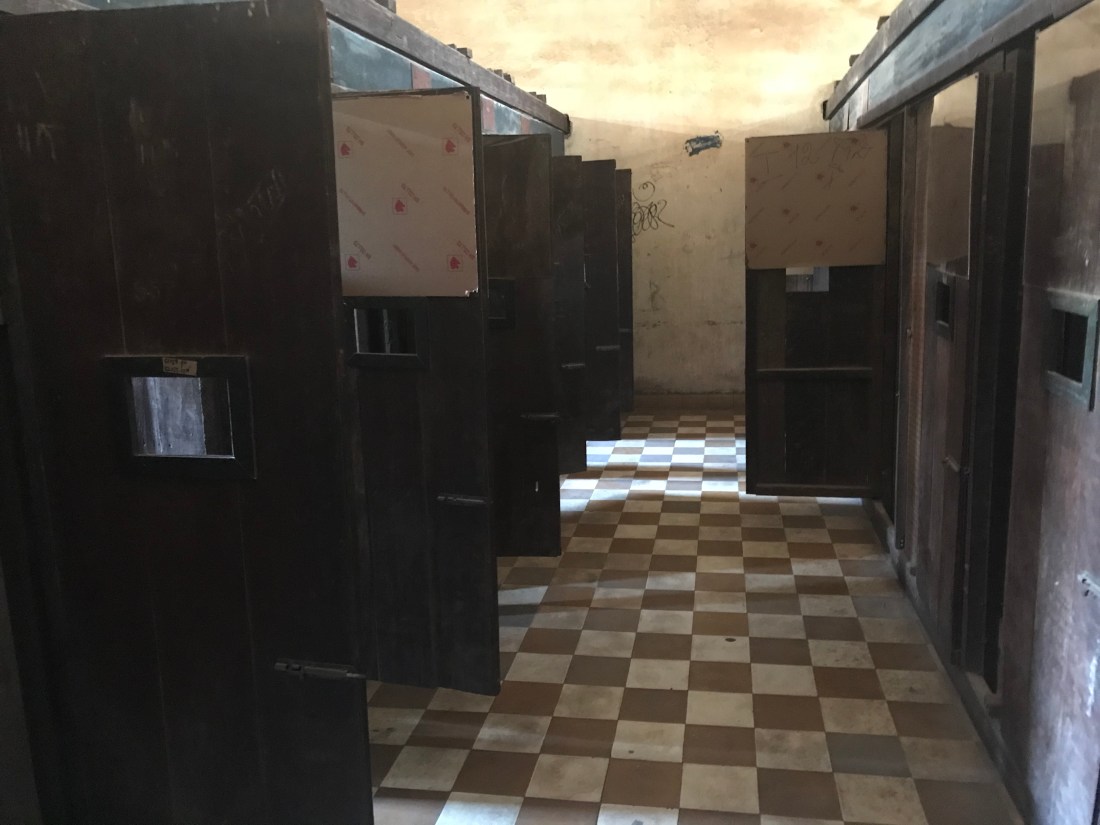
By the end of our time in Cambodia, we had a much greater understanding of the history here, and a huge sense of sadness and sympathy for the people. The message from all of these museums is a resounding “Never Again”, and it is a great thing to see the stress on education of the youngsters in the country growing up in their recent history in order to ensure that such a regime is never permitted to gain a foothold in the country again.
It should be pointed out that the country isn’t out of the woods yet, it will be 2025 before the programme clearing landmines from the countryside and jungles is completed. Until then those people who rely on farming or gathering wood and food from the forests are putting their lives and limbs at risk daily in order to provide for their families. The local people we spoke to told us of the political situation in the country, the government still in power is the remnants of the Khmer Rouge to this day. They are universally unpopular, but there is no faith in the democratic process. Elections are undoubtedly rigged and corruption is rife. I made a conscious decision to delay posting this until we had left Cambodia, as criticising the government online is illegal (apparently recent legislation even made the act of sharing posts doing so on social media).
With all this sad history and current political situation, it was a credit to the people of Cambodia that we felt they were so incredibly happy, positive, welcoming hosts. I truly hope that the international community and an increase of global communication can put enough pressure on the current regime in order to establish a country which functions for the benefit of the entire population.

 Melanie and Colin Go Travelling